As ISO 9001:2026 approaches, much of the discussion is focused on the changes to the standard itself.
However, I believe there is another question that deserves equal attention:
How do we know that an auditor is truly competent - not only knowledgeable?
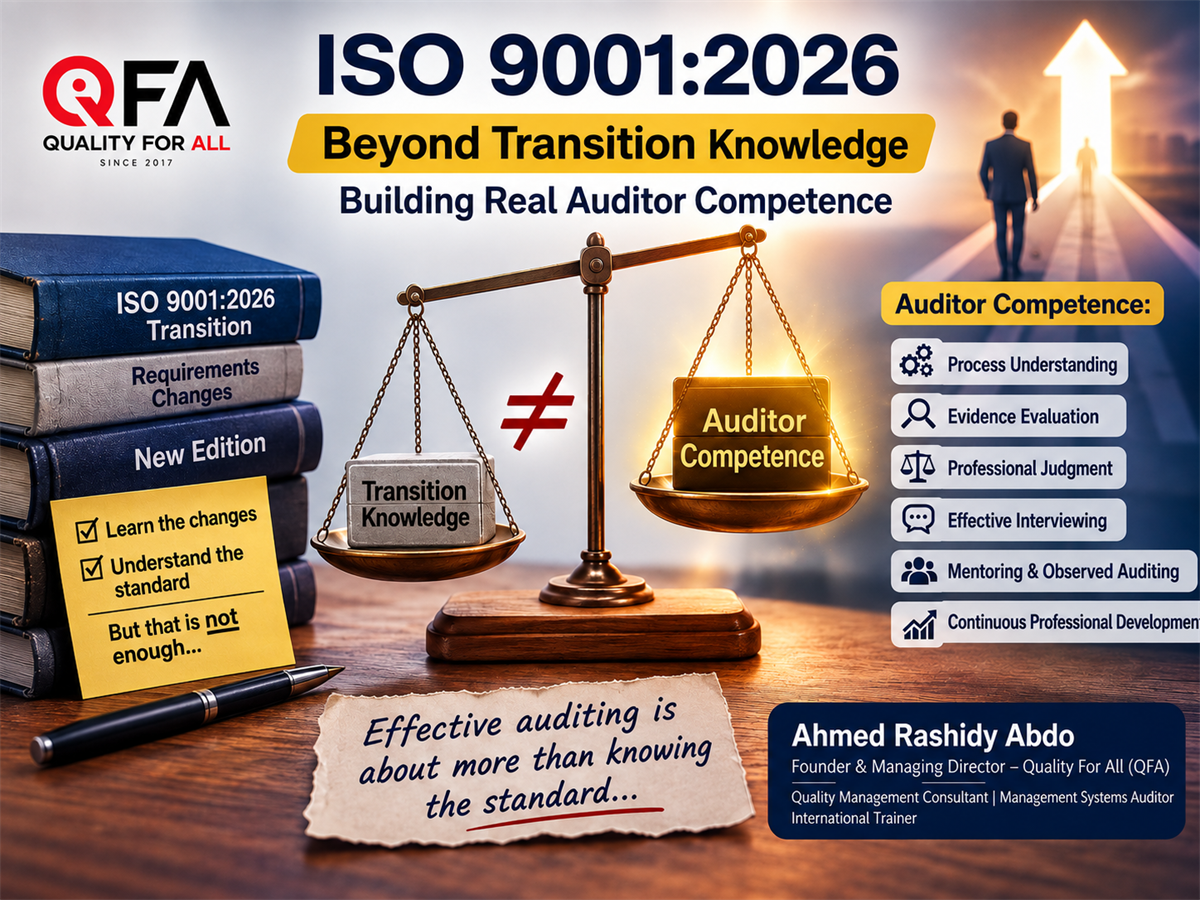
Understanding revised clauses, terminology and requirements is important. But effective auditing requires much more than transition knowledge.
A competent auditor must be able to understand how processes actually operate, evaluate objective evidence, identify meaningful risks, conduct effective interviews, recognise weak system effectiveness and apply professional judgement in complex situations.
This raises an important distinction:
Knowing the requirements is not the same as being able to audit them effectively.
There is also another dimension worth considering: the consistency and reliability of professional judgement.
Two auditors may review the same process, records and evidence, yet reach materially different conclusions. This raises questions about how auditor competence should be developed, demonstrated and maintained.
In practice, future auditor development may benefit from greater emphasis on:
- calibrated audit scenarios;
- observed audits and mentoring;
- inter-auditor comparison;
- evaluation of evidence-to-conclusion traceability;
- practical case-based assessment;
- periodic review of judgement consistency.
The transition to ISO 9001:2026 may therefore be an opportunity not only to update our knowledge of the standard, but also to reconsider how auditor competence itself is evaluated.
How should auditor competence be assessed beyond course completion and examination results?
And perhaps more importantly:
How can we determine whether an auditor's professional judgement is consistent, reliable and defensible?
I would be very interested to hear the perspectives of auditors, certification professionals, trainers and quality leaders within the Exemplar Global community.
------------------------------
Ahmed Rashidy Abdo
Founder & Managing Director | Quality For All (QFA)
Quality Management Consultant | Management Systems Auditor | International Trainer
Building professional competency and organizational excellence across the Middle East & Africa.
https://qfaplus.com
------------------------------